
Posey County Court Record Requests
Begin with MyCase, the free statewide portal. Search by case number if you have it, or by party, business, or attorney and pick Posey County. Treat the online CCS as a locator. It is not a guaranteed complete official file. When a paper is not linked there, call the Clerk of the Posey Circuit/Superior Courts at 812-838-1306 or write to kay.kilgore@poseycountyin.gov. The county posts no general copy-request form.
Want to go in person? The counters are split. Circuit sits at 300 Main Street, Room 115, and Superior at 126 East Third Street, Room 133, both in Mount Vernon. Hours run Monday through Friday, 8:00 a.m. to 4:00 p.m. Central Time. Call ahead to confirm which building holds your case file. The clerk posts no general mail procedure or fax request form, so ask before sending a request either way.
- Identify Circuit or Superior and the case number.
- Name the document or CCS event and its date.
- State whether the copy should be plain or certified.
- Ask about fee, payment, delivery, and expected turnaround.
- Use the reporter instead when the request is a transcript.
Posey Records Are Four Products
Ask for a "court record" and you might mean four different things. The CCS view is the event history and the quickest way to locate a case. A filed document is a single item. Think of a pleading, motion, order, judgment, exhibit, or attachment. A certified copy carries the clerk's authentication. A transcript is a word-for-word record made by the court reporter. Match the request to the right product, and you avoid delay.
| Record | What it provides | Primary route |
|---|---|---|
| CCS view | Chronological events, settings, and disposition entries | MyCase or clerk |
| Filed document | A specific public pleading, order, judgment, or exhibit | Online link or clerk |
| Certified copy | Clerk-authenticated copy for an official need | Clerk copy request |
| Transcript | Verbatim record of a reported proceeding | Court reporter |
These distinctions matter. A screen print is not a certification, and a CCS is neither a transcript nor the full Clerk's Record.
Kinds of Court Records
Posey County court case records cover criminal, civil, family, probate, estate, guardianship, trust, juvenile, traffic, and protective-order matters. Access varies by type. Public criminal and civil files may give you a CCS and selected orders. Adoption files are confidential, and many juvenile and mental-health cases are closed to the public. Protection orders sit behind a separate search built to shield victim information.
- Chronological Case Summaries and case-setting entries
- Complaints, petitions, answers, motions, and responses
- Orders, judgments, disposition papers, and public exhibits
- Probate, estate, guardianship, trust, and family records where public
- Certified decrees, licenses, and other clerk-held court documents
A marriage-license lookup runs through a separate state tool, and it does not replace a certified license copy. A criminal court file is its own thing too, distinct from a police arrest report, an Indiana State Police history, a Department of Correction custody record, or a BMV driver record.
Posey Online Documents Vary
The official MyCase document-access page lays out which case types generally post public orders or other documents online. Its table is only a starting point, though, and it promises nothing about any single Posey record.
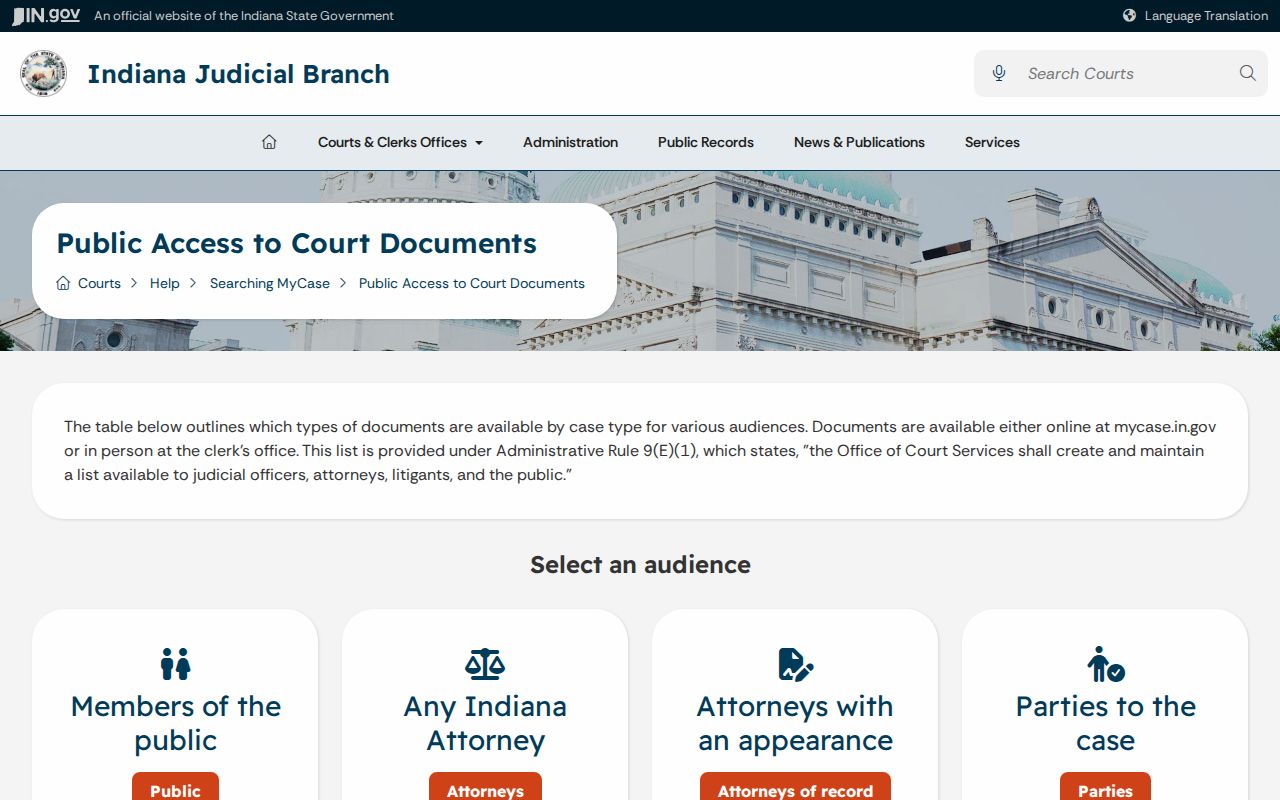
A case can stay public while certain papers stay hidden. Think of a financial affidavit. Or a protected address, a medical filing, a confidential report, or a sealed exhibit. Party and attorney accounts may see more in an authorized case. But the confidentiality rules still hold. A blank link can also mean an older converted event. It can mean a paper that was never digitized. Ask the clerk instead of reading absence as a legal access decision.
Court Records: What They Contain
The Clerk's Record reaches further than the CCS. It can hold the chronological history. It can also hold the papers, pleadings, orders, judgments, and documents that belong in the case file. What's inside depends on the case type, the access level, and what was filed. For a locator, nothing beats a uniform case number like 65C01-YYMM-TYPE-SEQUENCE or 65D01-YYMM-TYPE-SEQUENCE.
| Header | Case number, court, case type, filing date, status, and public caption. |
|---|---|
| CCS | Event dates, notation dates, descriptions, settings, transfers, and disposition. |
| Pleadings | Petitions, complaints, answers, motions, responses, and notices where accessible. |
| Orders and judgments | Signed rulings, final orders, and RJO references when public. |
| Exhibits | Filed attachments subject to sealing, confidentiality, and redaction rules. |
| Financial data | Costs or balances that should be confirmed with the clerk. |
One more timing trap: the event date and the entry date can differ. Read both before you build a timeline, and note that MyCase warns financial data may be stale.
Posey E-Filing Is Not Access
Filing and public access are two different systems. Attorneys submit through the Indiana Electronic Filing System via a certified provider. Self-represented filers are encouraged, but generally not required, to e-file. The official IEFS workflow shows how a provider moves a submission into the court system.
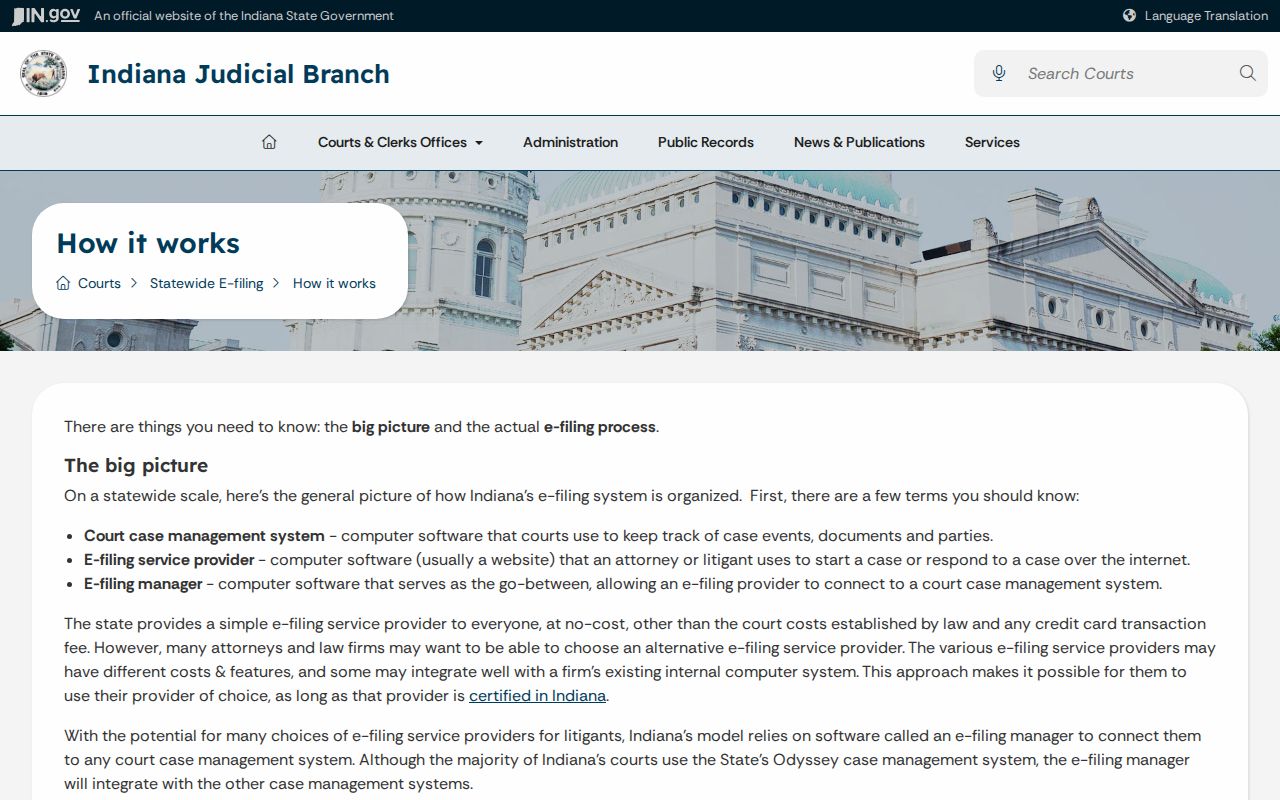
Submission, acceptance, service, CCS entry, and public display are separate steps. Uploading a paper does not make it public. Confidential material may need Form ACR, the Notice of Exclusion of Confidential Information from Public Access. It must cite the correct exclusion ground. After filing, the clerk and the court apply the access rules.
Copy Fees and Certification
For court-generated documents, Posey charges $1 per copy plus $3 per certification. Pay by cash, local personal check, money order, or major credit card. A card payment adds 2.6%, with a $1 minimum. The office offers no notary service. Ask whether certification covers the exact record you need. Also ask whether each document requires its own certification.
| Item | Posted amount or rule |
|---|---|
| Court-generated copy | $1 per copy |
| Certification | $3 per certification |
| Credit-card charge | 2.6%, $1 minimum |
| General search fee | Not posted |
| Transcript | Reporter rates; obtain a current quote |
Posey Circuit Clerk Counter
300 Main Street, Room 115
Mount Vernon, IN 47620
812-838-1306
Posey Superior Clerk Counter
126 East Third Street, Room 133
Mount Vernon, IN 47620
812-838-1306
Monday through Friday, 8:00 a.m. to 4:00 p.m. Central
Posey Historical Records Follow Another Path
Research into older Posey court records can reach beyond modern Odyssey. The Indiana State Library guide lists circuit, miscellaneous circuit, marriage, probate docket, probate-box, and microfilm holdings. Indiana Archives material covers early circuit records, chiefly from 1815 through 1855. It also describes an index with sixteen fields for terms, parties, causes, subjects, boxes, folders, and locations.
Genealogists and local historians get real value from those archives. Still, they cannot prove a modern case is missing from MyCase. Start with the clerk when you know a current or recent case. Turn to the State Library and Archives when age, format, or the historical collection points that way. The County Recorder keeps land instruments, mortgages, liens, and plats. None of those are court dockets.
Note: An archived index entry only locates historical material. It is no substitute for the underlying case papers.
Access Rules for Court Records
Indiana builds its court records rules around a simple idea. The file is open unless a rule says otherwise. Rule 5 spells out what stays confidential. That list runs long, covering many juvenile matters, mental-health files, adoptions, investigative material, and the protected data tied to victims and witnesses. When something sensitive sits inside an otherwise public document, redaction takes out only that piece and leaves the rest of the record intact. Rule 9 goes further. It gives a person a written path to challenge an exclusion, though it demands a real reason rather than plain curiosity.
Controlling sources: Indiana Code 5-14-3 is the general Access to Public Records Act. Access Rule 5 defines confidential court material, and Access Rule 9 governs requests for excluded records.
Form ACR is a filing notice, not an unsealing request. The person filing it marks confidential information. The filing states why it stays out of the Posey County court record. Members of the public cannot use it to open a sealed case. When a paper has no online link, the clerk's office is still the way to see it.
Federal Records Use Separate Systems
A Posey County case can end up in federal court. That means a whole different filing system. The county clerk has no part of it. Federal matters for this area go through the Southern District of Indiana. It keeps an Evansville Division. For any federal civil or criminal docket, you work with PACER and the federal CM/ECF system instead of the county's own records. The court’s CM/ECF information page spells out that separate federal channel.
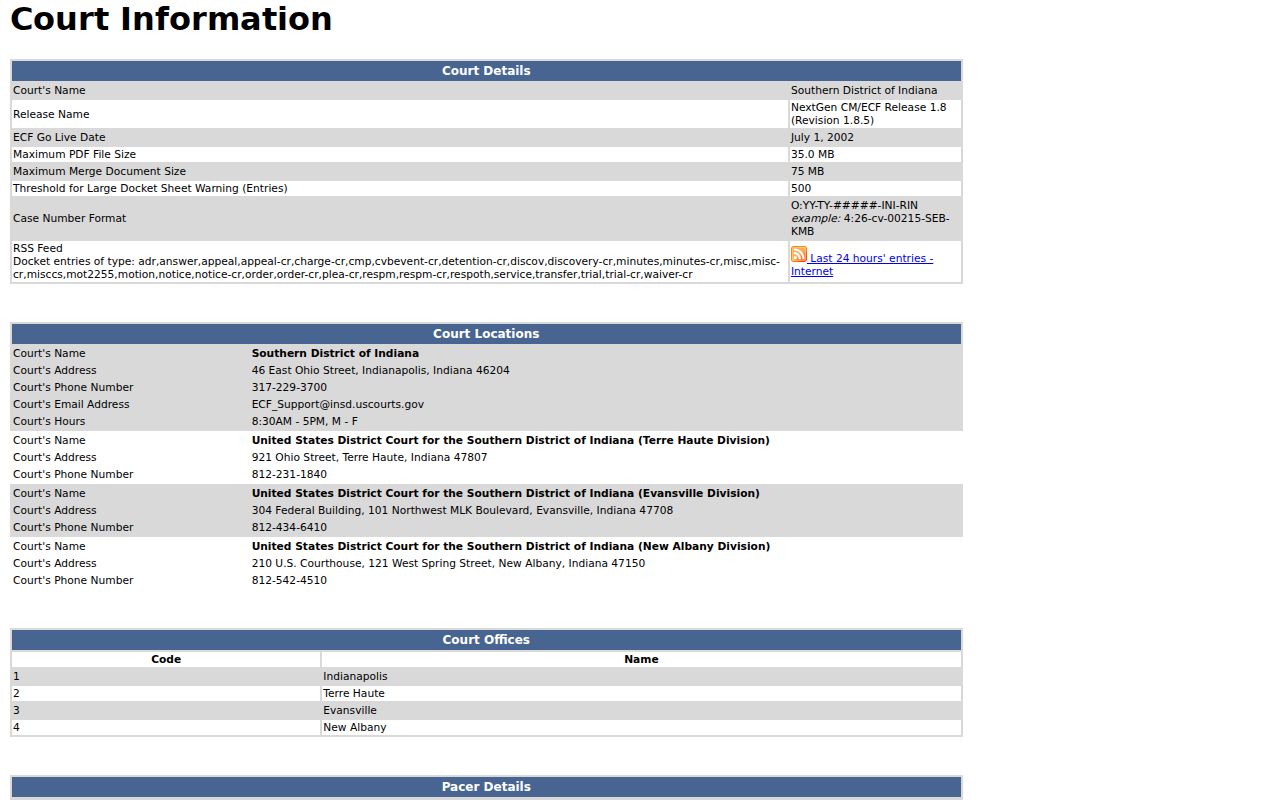
Two systems, two searches. Indiana trial-court cases live in MyCase. Federal cases live in PACER, and nothing merges the two just because the party or subject looks the same. Ask the federal clerk or PACER to verify a federal court record. The Posey County clerk cannot certify it. Bankruptcy runs on its own federal track too. The Southern District of Indiana Bankruptcy Court's Evansville page posts the intake and service details for this region. That official page is the place to check before calling anyone.
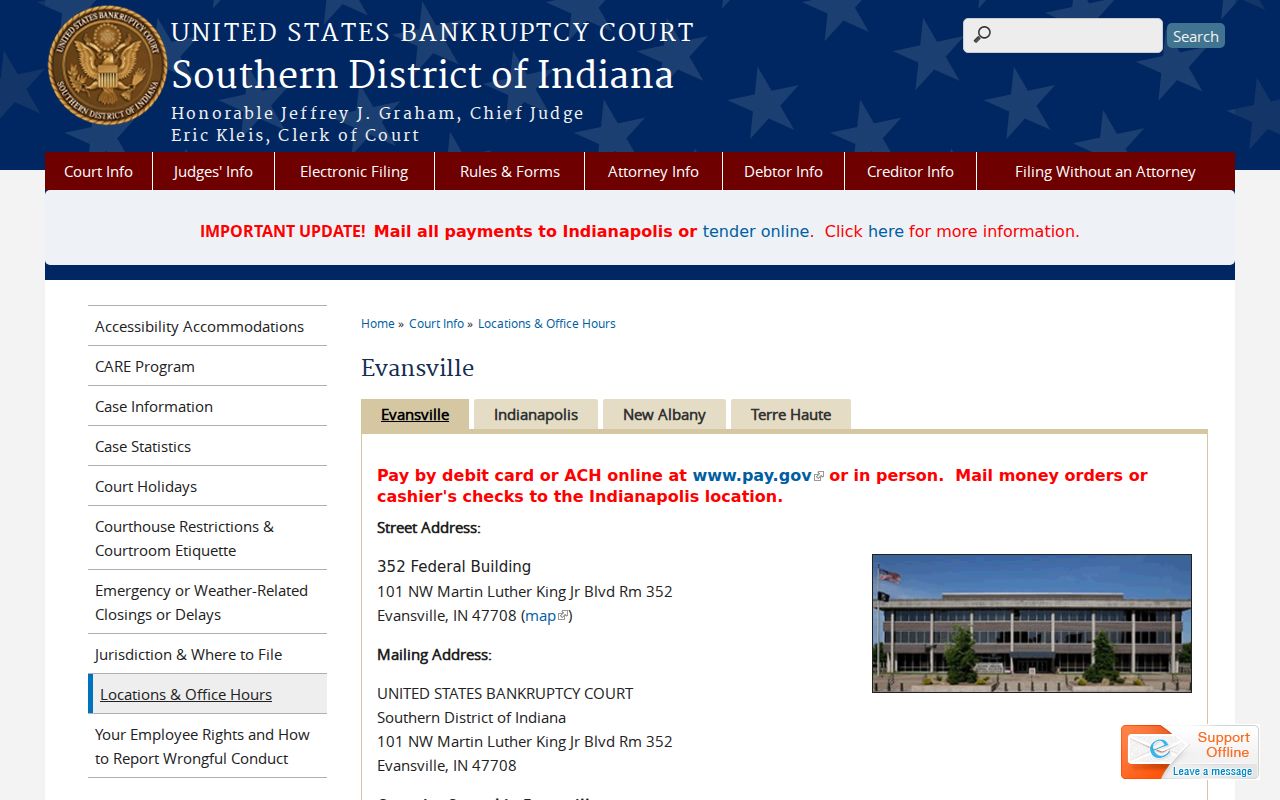
The custody rule stays simple: Posey County's clerk holds Circuit and Superior court records, while federal district and bankruptcy files sit in their own systems. A docket search in one never reaches the other.