
Posey County Civil Docket Searches
Indiana MyCase is the tool for public Posey County civil dockets. The Case tab takes a case number. The Name tab accepts a person or business. A trailing wildcard helps with spelling variants. You can also search by attorney name or bar number. Pick Posey County, then choose Civil, Family, or Probate as the category. Status and file-date filters narrow a long list.
The prefix tells you the courtroom. Numbers starting 65D01 belong to Posey Superior Court, while 65C01 means Posey Circuit Court. Older archived matters may still carry 65E01. If nothing comes back, call the unified clerk at 812-838-1306 or write kay.kilgore@poseycountyin.gov. Staff can confirm the right court. They can check a paper or converted file, and tell you whether a public document can be copied.
- Search a full case number when available.
- Otherwise use a party, business, or attorney field.
- Choose Posey County and the best category.
- Compare court code, filing date, caption, and status.
- Request the official document from the clerk when a link is absent.
Posey Civil Courts Split the Work
A case marked "civil" could sit in either Posey courtroom. Local rule LR65-AR1-02 sends a long list to Superior Court: domestic relations, CHINS and termination proceedings, small claims, eviction, civil plenary, collection, tort, mortgage foreclosure, ordinance violations, and protective orders. Circuit Court gets probate, adoption, estates, guardianships, trusts, name changes, tax-sale and tax-deed cases, and reciprocal support. Whatever remains is assigned randomly or split equally between the two courts.
| Current route | Common examples | Identifier |
|---|---|---|
| Superior Court | PL, CC, CT, MF, SC, EV, DC, DN, PO | 65D01 |
| Circuit Court | AD, ES, EU, EM, GU, GM, TR, TS, TP | 65C01 |
| Archived County Court | Converted older matters only | 65E01 |
Trust the case code and court identifier over the caption. Those details also point the clerk to the right counter and record location.
Civil Dockets: What They Show
The heart of the docket is the Chronological Case Summary, or CCS. It lists filings and court events in order. A Posey County civil docket header shows the court, case number, case code, filing date, status, caption, and judicial officer. Party blocks name roles like plaintiff, defendant, petitioner, respondent, creditor, or debtor. The event list tracks service, answers, motions, responses, settlement activity, settings, orders, judgments, transfer, and closure.
| Case header | Court code, case type, filing date, status, and public caption. |
|---|---|
| Party roles | Plaintiff, defendant, petitioner, respondent, creditor, debtor, and attorneys. |
| Pleadings | Complaint, petition, summons, answer, counterclaim, motion, and response. |
| Settings | Status, pretrial, settlement, motion, evidence, bench trial, or jury trial. |
| Disposition | Default, dismissal, settlement, judgment, trial result, transfer, or closure. |
| Privacy status | Public link, redacted filing, party-only access, sealed item, or exclusion. |
One caution on dates. An event may have happened on a different day than the CCS entry was keyed. Read both when they differ. And a public event with no file link still counts as part of the docket.
Posey Civil Codes in Plain Terms
Case codes read like shorthand once you know them. PL is civil plenary, CC is collection, and CT is tort. MF means mortgage foreclosure, SC means small claim, and EV means eviction. Domestic relations splits into DC with children and DN without. Estates come as ES, EU, or EM, guardianships as GU or GM, and TR means trust. PO stands for protection order, and that class has its own public-search route instead of the ordinary MyCase display.
- CCS
- The chronological court-event list, not the whole clerk’s file.
- Pleading
- A formal filed paper, such as a complaint, answer, petition, or motion.
- Default
- A court result tied to a party’s failure to respond or appear, as the order states.
- Continuance
- An order moving a setting to a later date.
- Certified copy
- A copy authenticated by the clerk for an official use.
Domestic, juvenile, adoption, and protective-order codes also warn you that privacy rules are tighter there. A case label never promises that every attachment is public.
What Cases Fill the Civil Docket
Civil dockets in Posey County hold very different kinds of files. A collection case may turn on a complaint, service, an answer, and judgment. A small claim runs a shorter path but still has a CCS and settings. Tort and plenary matters can pile up motions, discovery entries, settlement activity, and trial settings. Probate and estate cases route through Circuit under the current rule. Family and child-related matters face tighter access limits.
- Plenary, collection, tort, and mortgage-foreclosure cases
- Small claims and eligible eviction filings
- Domestic relations and reciprocal-support proceedings
- Probate, estate, guardianship, and trust matters
- Name-change, tax-sale, tax-deed, and miscellaneous civil cases
Protective orders carry no filing fee on the county page. Even so, their online access differs from an ordinary public civil case. Adoption and many juvenile matters stay confidential.
Posey Civil Filing Costs
The Posey clerk page posts figures a filer can plan around, though confirm current charges before submitting anything. An ordinary civil filing runs $157, plus $28 for sheriff service. A small claim costs $97 with the same posted sheriff add-on. Divorce is $157. Guardianship, estate, and trust filings are $177. Protective orders list no filing fee at all.
| Filing | Posted amount |
|---|---|
| Ordinary civil | $157, plus $28 for sheriff service |
| Small claim | $97, plus $28 for sheriff service |
| Divorce | $157 |
| Guardianship, estate, or trust | $177 |
| Protective order | No filing fee listed |
Attorneys must e-file through Indiana's electronic filing system. Self-represented people are encouraged but generally not required to do so. A service provider sends the filing in; acceptance and entry on the civil docket are separate steps.
Hearings on the Civil Docket
A civil setting on the Posey County docket can take many forms. Status conferences, pretrials, settlement talks, motion hearings, evidentiary hearings, eviction or foreclosure settings, and bench or jury trials all appear here. The entry should list the date, time, location, judicial officer, and type of setting. A setting is not always the final hearing. A reset or continuance should create a later event. The newest order controls.
Indiana Court Calendar is an opt-in tool. The live availability check on August 23, 2026 did not list a participating Posey court. An empty result does not mean no hearing exists. Use the CCS and call the unified clerk with questions. Circuit judge-office matters can use 812-838-1302. Superior judge-office matters can use 812-838-1325, and clerk record questions go to 812-838-1306.
Note: Confirm an urgent Posey County civil setting directly, because a blank statewide calendar is not proof of cancellation.
Posey Civil Access Is Layered
The official Access to Court Records Rule 4 builds the public-access framework for the Posey County civil docket while keeping excluded parts protected. The rule shows why public captions, CCS events, and downloadable files sit in separate access layers.
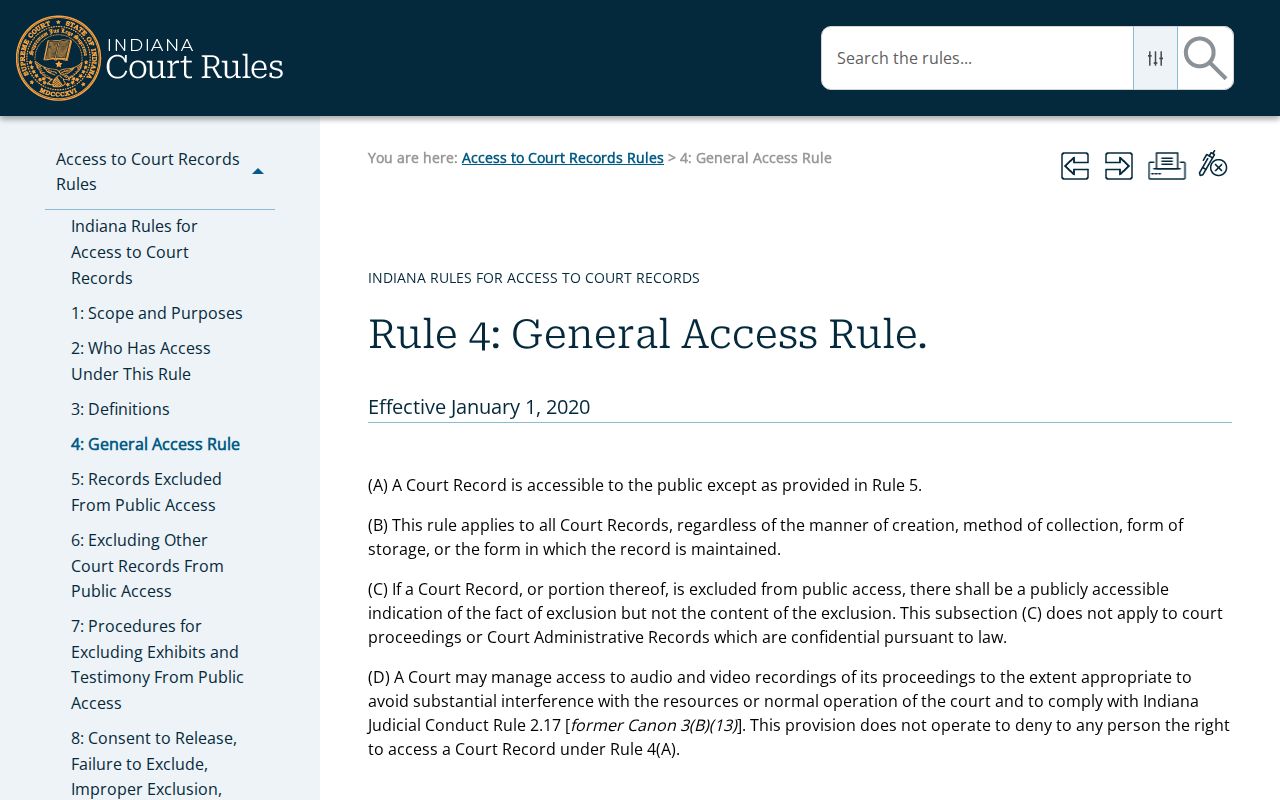
For Posey County civil dockets, this layered design has practical effects. A public case may show an event on its docket while withholding a financial affidavit, a protected address, a confidential report, a sealed exhibit, or another excluded filing. Check the court's public-document table by case type. One caution matters: a missing attachment does not erase the public CCS event.
Who Can See Civil Dockets
Most nonconfidential civil cases in Posey County carry public docket information. Access tightens for adoption, juvenile, mental-health, protection-order, and sealed matters. Domestic-relations files can hold protected papers even when the caption and basic events stay public. Redaction strips out Social Security numbers, account numbers, passwords, and protected addresses. It also removes other data defined by rule.
Indiana access structure: Rule 1 states the presumption, Rule 5 lists confidential material, and Rule 9 governs verified requests for excluded records.
Parties get more in their own case. An account and access code can open additional documents. Still, party access cannot override every exclusion. Anyone seeking excluded material must follow Rule 9 rather than keep repeating online docket searches.
Posey Rules Change in 2027
Indiana's Supreme Court approved amendments to Posey LR65-AR1-02 and LR65-AR1-03 on July 31, 2026. They take effect January 1, 2027. The rules now in force still govern today. Do not apply the future allocation to a case lookup made under them. Once the amendments apply, confirm the amended rule. Use the actual case identifier rather than assuming an older court assignment still controls.
The careful docket search method outlasts the change. Locate the case number. Read its court code. Confirm transfers in the CCS, and ask the clerk when the online path is unclear. The official local-rules orders index supplies dated authority for amendments.